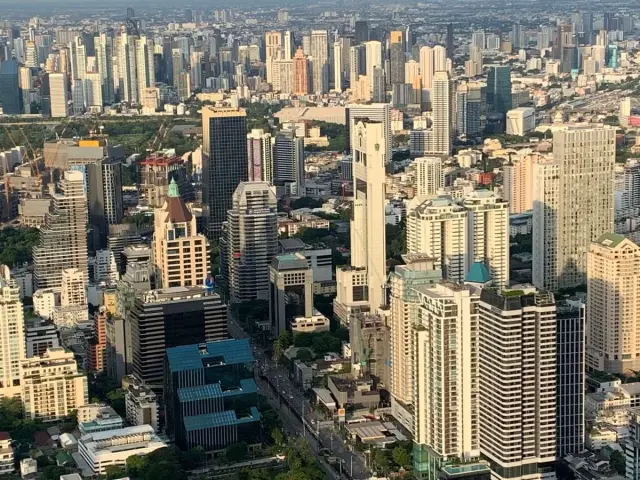
Wondering what to pack? Bangkok weather by month is hot all year, with the driest stretch running roughly November to February and the heaviest rain in September.
If you are still sketching out the trip, the bangkok travel guide for visitors covers the wider planning picture.
| Item | Value |
|---|---|
| Hottest month (average daytime high) | April, 35°C |
| Coolest nights | 21°C in January and December |
| Wettest month | September, 292 mm over 20 days with some rain |
| Driest month | January, 8 mm |
| Heat and humidity peak | Extreme in April and May |
| Climate type | Tropical savanna (dry winter), Köppen Aw |
These figures are long-term averages from Weather2Travel and Climate-Zone. They can change as datasets are updated, so check the source before you rely on them.
Bangkok’s climate in a nutshell
Bangkok has a tropical savanna climate (Köppen Aw) with a dry winter, which Climate-Zone describes as remarkably steady. Weather2Travel puts it more simply: a hot tropical climate with a winter dry season.
The big swing is wet versus dry, not hot versus cold. In Weather2Travel’s data, average daytime highs stay between 31°C and 35°C all year, while monthly rainfall runs from 8 mm in January to 292 mm in September.
Climate-Zone counts about 282 days a year above 32°C. Expect heat on most days, whatever the month.
Bangkok weather by month at a glance
Here is how the year breaks down, month by month. Rain days are days with some rain, not days of constant rain.
| Month | Daytime high (°C) | Night-time low (°C) | Rainfall (mm) | Days with some rain |
|---|---|---|---|---|
| January | 32 | 21 | 8 | 1 |
| February | 33 | 23 | 21 | 3 |
| March | 34 | 25 | 31 | 3 |
| April | 35 | 26 | 68 | 6 |
| May | 34 | 26 | 182 | 15 |
| June | 33 | 26 | 159 | 15 |
| July | 33 | 25 | 167 | 17 |
| August | 32 | 25 | 207 | 19 |
| September | 32 | 25 | 292 | 20 |
| October | 32 | 24 | 199 | 16 |
| November | 32 | 23 | 49 | 6 |
| December | 31 | 21 | 11 | 1 |
The table shows long-term averages from Weather2Travel, and figures can change, so check the source before you rely on them. Read across a row to see how fast conditions change. Between April and May, rain days rise from 6 to 15 and monthly rainfall from 68 mm to 182 mm, which is the clearest seasonal switch in the table.

What each season feels like
This guide groups the months by what the numbers show, not by an official calendar. Three stretches stand out.
November to February: the drier months
Rain is rare. In Weather2Travel’s figures, November has 6 days with some rain and 49 mm, while December and January have just 1 rain day each, with 11 mm and 8 mm.
Daytime highs run from 31°C to 33°C, and nights fall to 21°C in December and January. Heat and humidity are rated high rather than very high in November, December and January.
Humidity builds early, though. Climate-Zone’s modelled estimates show relative humidity of 66% in January and February against 80% in November.
March to May: the hottest months
April is the peak. Weather2Travel gives a daytime high of 35°C and a night-time low of 26°C, and rates heat and humidity as extreme in April and May. Climate-Zone’s 1991-2020 normals put the April average high near 36°C.
March and April are still fairly dry, with 3 and 6 rain days. Sunshine eases from 9 hours a day in January to 7 in May as the rain arrives.
June to October: the rainy months
Rain falls on 15 to 20 days a month, peaking in September with 20 rain days and 292 mm, according to Weather2Travel.
The sky is mostly overcast. Climate-Zone estimates cloud cover between 87% and 91% from June to September, with relative humidity of 80% to 84% from June to October.
Weather2Travel’s tropical storm table, on the same page, shows no more than 2.1% of any month affected. A rain day also means some rain, not a washout, so plan around showers rather than cancelling.
Why do weather sources give different numbers?
Three sources agree on the pattern but not on exact rainfall. September is the wettest month in each, yet the averages differ:
- Weather2Travel: 292 mm in September.
- Climate-Zone: 341 mm in September and about 1729 mm a year.
- Airpult: 256 mm in September and approximately 1,274 mm a year.
Climate-Zone builds its temperature and rain figures from 1991-2020 normals, using 28 years of daily observations at a station about 7 km from the city centre. Airpult says its values are averages over more than 10 years of data. A different station, period and method are the likely reasons for the gaps.
The driest month shifts too: January at Weather2Travel (8 mm), December at Climate-Zone (12 mm) and at Airpult (17 mm). Treat the numbers as a guide to the pattern, and read the ranking of months rather than a single millimetre figure.
Planning around Bangkok’s weather
The averages translate into a few practical habits:
- Light, breathable clothing all year, as daytime highs stay between 31°C and 35°C.
- A compact umbrella or rain jacket from May to October, when every month has 15 or more rain days.
- Sun protection, since the maximum UV index reaches 11 in most months, according to Weather2Travel.
- Indoor backup plans for September, the wettest month in all three sources.
If you need a timing recommendation rather than raw averages, read our guide to the best time to visit bangkok.
Because the weather affects how far you want to travel each day, the guide on where to stay in bangkok for business is worth reading alongside this one.
Frequently asked questions
What is the hottest month in Bangkok?
Show answer
April. Weather2Travel lists a daytime high of 35°C and a night-time low of 26°C, and Climate-Zone gives an average high near 36°C.
Which month has the most rain?
Show answer
September, though the total depends on the source: 292 mm at Weather2Travel, 341 mm at Climate-Zone and 256 mm at Airpult.
Does Bangkok ever get cold?
Show answer
No. In Weather2Travel’s data the coolest nights are 21°C in December and January, and daytime highs never drop below 31°C.
Which months are driest?
Show answer
December, January and February. Weather2Travel shows 11 mm, 8 mm and 21 mm of rain, with 1, 1 and 3 days with some rain.