Worried your greenhouse will bake in a hot, humid climate? The greenhouse farming basics come down to one thing: shed heat. Ventilate first with big roof and side vents, then add shade or misting.
This guide sits within the wider topic of agriculture in thailand, and it looks at how protected cultivation copes with warm, humid conditions.
| Item | Value |
|---|---|
| Interior temperature unfavourable for plant growth in tropical Asian tunnel houses | Beyond 35°C |
| Enlarged roof vent in a Sri Lanka trial | Up to 36% of the floor area |
| Mean daytime temperature with enlarged roof vent and net-covered side vents | Down to the outside level (33°C) |
| Interior relative humidity with those vents | 63-65% |
| Interior temperature with misting plus improved natural ventilation | 30°C |
| Common temperature gradient in a fan-and-pad greenhouse | 3.9-5.6°C (7 to 10 degrees F) |
These figures come from the FAO AGRIS record of a 2014 Sri Lanka study and the Greenhouse Management fan-and-pad chapter. Figures can change, so check the source before you rely on them.
Why heat is the first problem to solve
A greenhouse keeps crops dry and protected, but it also traps solar energy. According to the Greenhouse Management ventilation chapter, without ventilation and cooling, high greenhouse temperatures could severely impact plant growth.
The numbers matter in the tropics. A 2014 study of tunnel greenhouses in tropical Asia found that relying on natural ventilation alone is inadequate during less windy and peak hot periods. Interiors can then heat up beyond 35°C, which is unfavourable for plant growth and development.
The problem is not limited to one country. An ISHS paper on Australian greenhouses notes that dry bulb temperatures over 35°C are common at many sites, and that crops there are potentially at risk.
The same chapter lists what ventilation is meant to do:
- Control high temperatures caused by solar radiation.
- Keep relative humidity at acceptable levels.
- Provide uniform airflow through the whole greenhouse.
- Maintain acceptable levels of gas concentration.
Ventilation comes first in greenhouse farming
The Greenhouse Management chapter describes three basic systems for ventilation and cooling: natural, forced-air and evaporative cooling. Natural ventilation is driven by wind pressure around the greenhouse and by the buoyancy of warmer, more humid air inside, as the chapter explains.
A Sri Lankan trial shows what vent design can do. An enlarged roof vent (up to 36% of the floor area) with a net-covered side vent (mesh size 20 or 40) brought the mean daytime temperature down to the outside level of 33°C. Relative humidity stayed at 63-65%, according to the AGRIS record.
Read this result with care. The test used a commercial-scale greenhouse without vegetation inside, under humid tropical conditions in Sri Lanka, so a planted house may behave differently.
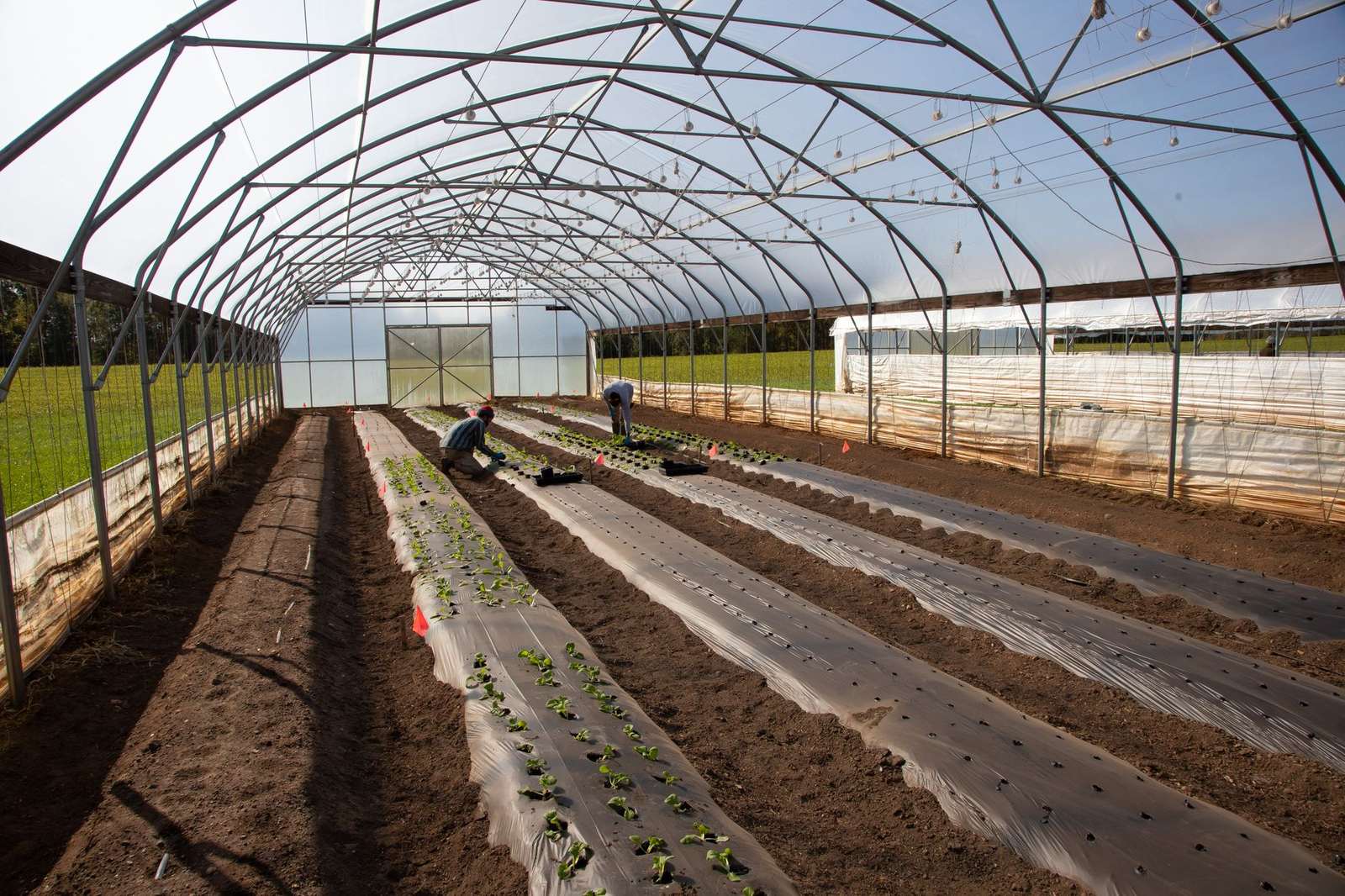
The same study found that forced-air intake was more effective for temperature regulation than exhaust when added to naturally ventilated greenhouses. In other words, fans that push air in may serve a vented tunnel house better than fans that pull air out, as the AGRIS abstract reports.
Adding evaporative cooling when vents are not enough
The ISHS paper groups the options for hot regions into four families, as listed in its abstract:
- Greenhouse design: shape, dimensions and roof configuration.
- Reducing solar load through shading and venting.
- Forced air circulation.
- Evaporative cooling.
Misting is the simplest evaporative step. In the Sri Lanka work, misting with improved natural ventilation reduced the internal temperature far below the outside, to 30°C, at the price of a slight increase in relative humidity. The authors add that forced-air ventilation could be used to bring that humidity back down with further improvements.
Fog systems installed throughout the greenhouse give a more uniform cooling pattern than pad-and-fan systems, according to the Greenhouse Management chapter. In both cases, ventilation is still needed to exhaust humidified air and swap it for drier air so evaporative cooling can continue.
How a fan-and-pad house works
In a fan-and-pad greenhouse, exhaust fans sit on one wall and wet pads on the opposite wall, so fresh air is drawn through the pads. Air warms as it crosses the house, so the pad side is coolest. A gradient of 3.9-5.6°C (7 to 10 degrees F) is common, according to the fan-and-pad chapter, though the gradient should be kept minimal.
Upkeep decides whether the system keeps working:
- Deliver water to the top of a 4-inch (10cm) thick pad at 0.5 gallons per minute per linear foot of pad (6.2 L/min/m), as the chapter specifies.
- Clean pumps and sumps several times during the months of summer operation to prevent algae and sediment clogging, per the same source.
- Watch for clogged pad areas, because exhausted air enters the building at the point of least resistance.
Shade, plastic films and insect screens
Shade curtains help reduce the energy load on a crop during warm and sunny conditions, and they reduce heat radiation losses at night. Movable curtains can run automatically from a light sensor or timer, and even low-cost greenhouses can benefit from a shade system, says the Greenhouse Management chapter.
Cladding is a topic of its own. The ISHS symposium on tropical and subtropical greenhouses included a paper titled “Tropical and Subtropical Greenhouses – A Challenge for New Plastic Films”, which signals that plastic choice is not a minor detail in warm regions.
Insect screening also affects airflow. The contents of a tropical greenhouse book give insect screening its own chapter, including a section on the enlargement of screened vent openings.
Site, water and where to read next
Placement can help or hurt cooling. Where possible, pads belong on the prevailing summer wind side and fans on the downwind side, and fans should not blow warm, moist air toward the pads of an adjacent house within 50 feet (15.2m), according to the fan-and-pad chapter.
The book’s table of contents also covers site selection, rainwater collection and storage, and a worked crop-water example for Bangkok (Thailand). Water planning is a large part of greenhouse farming in a warm climate, and our guide to smart irrigation systems covers the delivery side.
If you want to compare a vented greenhouse with a fully enclosed approach, vertical farming explained sets out the contrast.
A practical order of decisions
The sources point to a clear sequence. Work through it before you spend on equipment:
- Check the site and the prevailing summer wind before fixing the layout.
- Maximise natural ventilation with large roof vents and screened side vents.
- Add shade to cut the solar load.
- Add misting, fog or fan-and-pad cooling only if the house is still too hot, and plan how to exhaust the extra humidity.
- Schedule cleaning for pads, pumps and sumps so cooling does not fade mid-season.
Frequently asked questions
How hot is too hot inside a greenhouse?
Show answer
The 2014 AGRIS study describes interior temperatures beyond 35°C as unfavourable for plant growth and development. Crop-specific limits vary, so check them for your own crop.
Is natural ventilation enough in the tropics?
Show answer
Often not on its own. The same study calls it inadequate during less windy and peak hot periods, which is why combined strategies were tested.
Does misting raise humidity?
Show answer
Yes, slightly. The Sri Lanka trial recorded a slight increase in relative humidity with misting, and suggested forced-air ventilation could help bring it down.
Do I need a fan-and-pad system?
Show answer
Not necessarily. The Greenhouse Management chapter names three basic systems, and fan-and-pad is one evaporative option among them, alongside fog.